FORWARDMountain Radio Beacon Project
RESEARCH PROJECT

FORWARD PROJECT

Mountain Radio Beacons
for Safer Communities

Research for resilient connectivity in mountainous and rural areas

PROJECT OVERVIEW

Overview

Research, Development and Deployment of Resilient IoT Systems
to Prevent Communication Isolation in Mountainous and Rural Areas

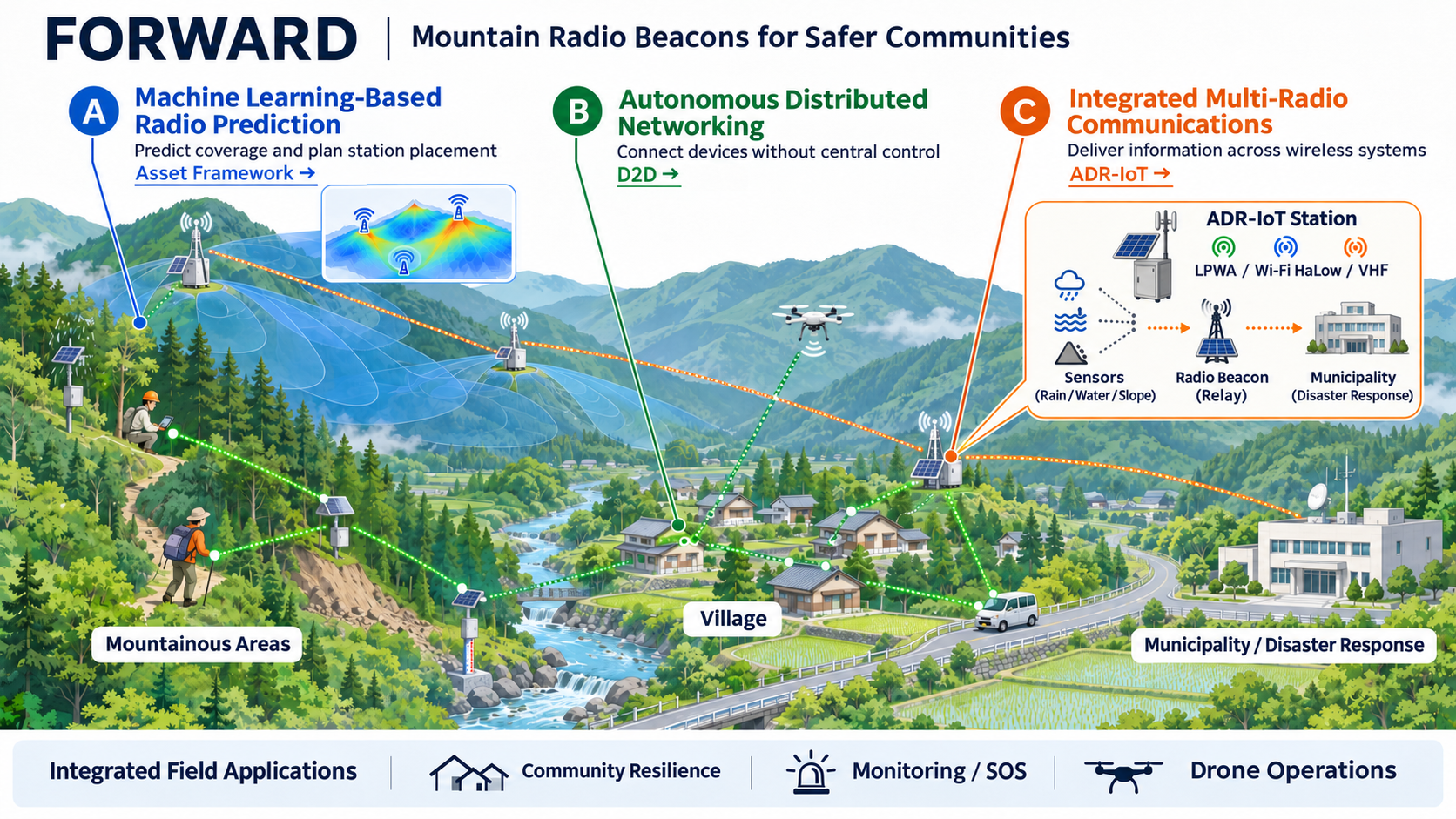
Mountainous and rural areas include places beyond cellular coverage and communities at risk of losing communications during disasters. Guided by the concept of “Mountain Radio Beacons,” FORWARD develops communication infrastructure to support everyday community monitoring and information delivery during emergencies. We combine machine learning-based radio propagation prediction, autonomous distributed networking and integrated use of multiple wireless technologies in an Autonomous Distributed Resilient IoT (ADR-IoT) system. The project aims to prevent community isolation, support the safety of hikers, forestry workers and older people, and assist drone operations.

Figure 1. The FORWARD Mountain Radio Beacon concept

Select A / B / C in the illustration to explore each technology.

TECHNOLOGY

Technology

01

Data-Driven Machine Learning for Signal Strength Prediction

Machine learning uses environmental information, such as terrain, buildings and forests, together with measured radio data to predict received signal power at each location. Transfer learning and federated learning help make effective use of limited measurements, supporting coverage estimation and the placement of base stations and relay nodes.

02

Direct Device Communication

Nearby wireless devices exchange information directly without passing through a cellular base station. We study how devices carried by people or vehicles can share and deliver sensor readings, location information and SOS messages, even outside cellular coverage.

03

Autonomous Distributed Networking

Devices and stations connect and cooperate according to local conditions without relying on a central controller. By relaying and sharing information across multiple nodes, we aim to build networks that can maintain communications even when some devices stop operating.

04

LPWA for IoT Communications

Low Power Wide Area (LPWA) technologies deliver small amounts of data over wide areas with low power consumption. They can collect rainfall, river levels, slope conditions and location information. Combining frequency bands and communication methods suited to the terrain and application helps support monitoring in mountainous and rural areas.

05

Semantic Communications

Semantic communications focus on the meaning and task-relevant information within images and sensor data. For example, extracting and transmitting the type and location of an anomaly from monitoring images can reduce traffic while conveying information needed to understand the situation. We explore more efficient information delivery where communication capacity is limited.

RESEARCH ORGANIZATION

Research Organization

The following three institutions collaborate on core technologies, field evaluations and preparations for deployment in local communities.

Lead Institution
National University CorporationOrganization for Information and Digital Transformation, Shinshu University
Partner Institution
National Research and Development AgencyNational Institute of Information and Communications Technology NICT
Partner Institution
National Research and Development AgencyNational Research Institute for Earth Science and Disaster Resilience

RESEARCH OUTPUTS

Research Outputs

Project research outputs will be presented as journal articles, international conference presentations and patents.

Journal Articles

Content is being prepared.

International Conferences

Content is being prepared.

Patents

Content is being prepared.